


Bitcoin price has recovered above $61,000 after falling to roughly $55,100 over the weekend, with short covering and the unwinding of leveraged trades helping the cryptocurrency regain ground despite continued pressure from exchange-traded funds.
Summary
- Bitcoin price rebounded above $61K after touching $55.1K, helped by short covering and liquidations.
- CoinGlass recorded $68.82M in Bitcoin short liquidations within one hour as prices recovered.
- Binance Bitcoin funding turned negative, indicating a more bearish stance among futures traders.
- U.S. spot Bitcoin ETFs lost about $1.25B during Nov. 16–20 despite the weekend price rebound.
- Arthur Hayes warned of $50K downside risk, while Doctor Profit sees a 53K–62K bottom zone.
According to crypto.news market data, Bitcoin price traded near $61,500 after reaching its lowest price since September 2024 on Saturday. At press time, the flagship crypto was up nearly 4% over 24 hours, although it remained 5% lower over seven days.
Meanwhile, the rebound followed a sell-off that pushed the cryptocurrency below $60,000 and triggered heavy liquidations across trading platforms.
Bitcoin price rebounds as short liquidations fuel buying
The initial recovery followed roughly $2.67 billion in crypto liquidations over 24 hours, most of them involving traders betting on rising prices. Those forced sales intensified the weekend decline, but the balance changed once Bitcoin began climbing from its intraday low.
CoinGlass recorded $68.82 million in Bitcoin short liquidations within one hour of the rebound, compared with $1.64 million in long liquidations. Closing a short position requires buying back the asset, creating demand even when investors are not opening new long-term positions. As crypto.news previously documented, the rebound coincided with this burst of short covering, not a confirmed return of sustained spot demand.
Separate liquidation research cited CryptoQuant data showing Bitcoin open interest falling $2.54 billion across Binance, Gate and Bybit over 30 days. Analyst Amr Taha reported that short-term holders transferred 92,100 BTC to exchanges at a loss on November 21, pointing to considerable stress among recent buyers. Transfers to exchanges do not establish that every coin was subsequently sold.
The recovery was not limited to Bitcoin. Total cryptocurrency market capitalization rose 2.88% over 24 hours, while BTC trading volume fell 37%. The lower turnover leaves the strength of new buying harder to establish after the initial liquidation-driven move.
Negative Bitcoin funding rates show bearish positioning remains
CryptoQuant analyst Darkfost reported that Bitcoin funding rates on Binance had turned negative during the decline. In perpetual futures, negative funding generally means traders holding short positions pay those holding longs, indicating more aggressive demand for bearish exposure.
Darkfost noted that Bitcoin had retreated 56.3% from its previous all-time high and was down 17.4% in November when he published his assessment. He viewed the concentration of bearish positions as a possible contrarian signal because similar conditions sometimes emerge after substantial corrections.
“Historically, they rarely emerge when Bitcoin is trading near its highs,” he wrote, while cautioning that negative funding has preceded short-lived recoveries as well as more durable rebounds.
The positioning developed alongside declines in U.S. equities and precious metals. He cited a Nasdaq drawdown exceeding 20% from its peak and an S&P 500 decline approaching 12%, while persistent inflation raised expectations of another Federal Reserve rate increase in December. Earlier market sentiment data showed bearish commentary taking hold as BTC fell below $60,000.
Bitcoin ETF outflows continue despite weekend recovery
Institutional fund flows have not yet shown the same turnaround. Farside Investors recorded $582.3 million in net withdrawals from U.S. spot Bitcoin ETFs on November 19, including $541.1 million from BlackRock’s IBIT. Its available November 20 table showed another $124.5 million leaving the products, bringing the November 16–20 weekly total to approximately $1.25 billion on the reported figures.
Those redemptions came before the weekend rebound, when U.S. ETFs were closed. The next trading session on November 23 will provide a new reading of institutional demand after the recovery.
Earlier ETF market coverage documented losses among recently established positions while Bitcoin traded below the prices paid by many investors.
The fund withdrawals contrasted with on-chain movements by some large investors. Lookonchain reported that Abraxas Capital withdrew 17,597 BTC from Binance and Kraken at an estimated average price of $59,206.
Analysts weigh $55K retest against a possible Bitcoin bottom
BitMEX co-founder Arthur Hayes warned that continued weakness in technology shares could send Bitcoin back toward $55,000, with $50,000 possible if Nasdaq selling persists. His remarks followed renewed declines in Asian equities, including South Korea’s KOSPI and Taiwan’s stock market.
Crypto analyst Doctor Profit took a different view, identifying $53,000–$62,000 as a potential bottoming range.
“Nobody catches the exact bottom, and I am not trying to,” he wrote.
He pointed to Bitcoin’s proximity to an estimated realized price of $53,700, deeply oversold conditions and falling open interest, but acknowledged that previous bear markets had spent extended periods below realized price.
On the November 23 daily chart, Bitcoin remained below its nine-day moving average of $62,458 and 21-day average of $69,039. The daily relative strength index stood at 27.31, below the conventional oversold threshold of 30.
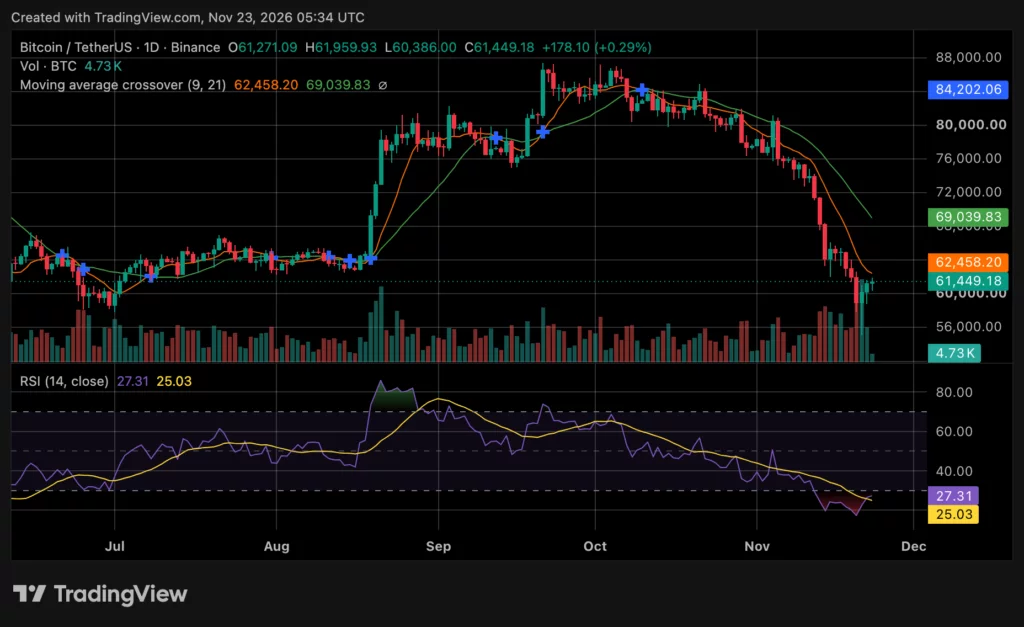
A recovery above $62,500 would put the $65,000 area in view, while a break below $60,000 would expose $57,800 and the recent $55,100 low.
Disclosure: This article does not represent investment advice. The content and materials featured on this page are for educational purposes only.
