


Aave price could fall over 40% in the coming weeks as two bearish patterns threaten to wipe out its remaining support levels.
Summary
- Aave price drops over 9% in 24 hours, extending losses to more than 50% from its year to date high.
- Bearish signals, including a double top and a death cross, point to a potential decline toward the $50 level.
- Departure of key contributors like Chaos Labs leaves Aave without a risk manager, raising concerns over protocol stability.
According to data from crypto.news, Aave (AAVE) price fell over 9% in the past 24 hours, extending its losses to more than 50% from its year-to-date high. The token remains under pressure as multiple bearish signals continue to build on its weekly chart.
Aave price has formed a massive double top pattern, a widely tracked bearish setup in technical analysis. The breakdown below the neckline at $114 confirmed the pattern and pointed to a potential continuation of the downtrend in the coming weeks.
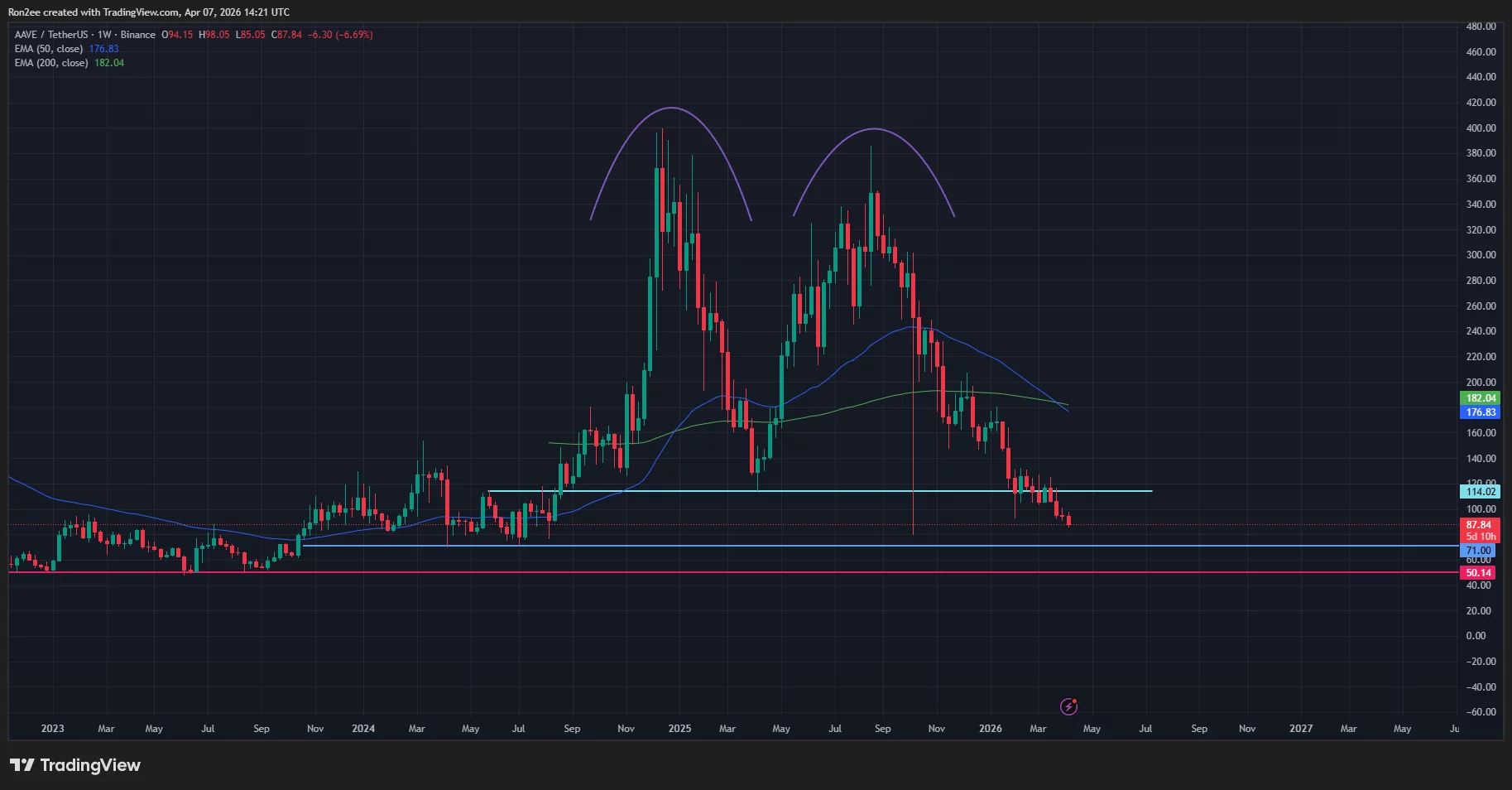
At the same time, price action has also triggered a death cross, with the 50-day simple moving average slipping below the 200-day average. Traders often interpret this crossover as confirmation of a longer-term bearish trend.
For now, the $71 level, which acted as strong support in April 2024, remains the last key zone where bulls could attempt a defense. A break below this level may open the door for a deeper decline toward $50, a level that served as a major floor throughout 2023.
Beyond the bearish technical setup, mounting internal challenges are adding further downside pressure to Aave’s outlook.
The protocol’s roughly $50 billion in total value locked is currently operating without a dedicated risk manager following the departure of Chaos Labs, a firm that had overseen core lending parameters since 2022. Its exit removes critical expertise tied to loan pricing, liquidation thresholds, and interest rate management across markets.
This development is part of a wider trend of contributor exits. Other key groups, including BGD Labs and the Aave Chan Initiative, have also stepped away, leaving the protocol without several of the original contributors behind its V3 system. The timing is notable as Aave is simultaneously preparing for its transition to the V4 upgrade.
The departures appear linked to governance disagreements around compensation structures and risk management frameworks. However, the immediate effect is a clear gap in oversight across a multi-billion-dollar protocol.
Such a vacuum in risk management has raised concerns around security and operational stability. Over time, this could weaken confidence among institutional participants that rely on Aave’s track record of reliability.
Disclosure: This article does not represent investment advice. The content and materials featured on this page are for educational purposes only.
